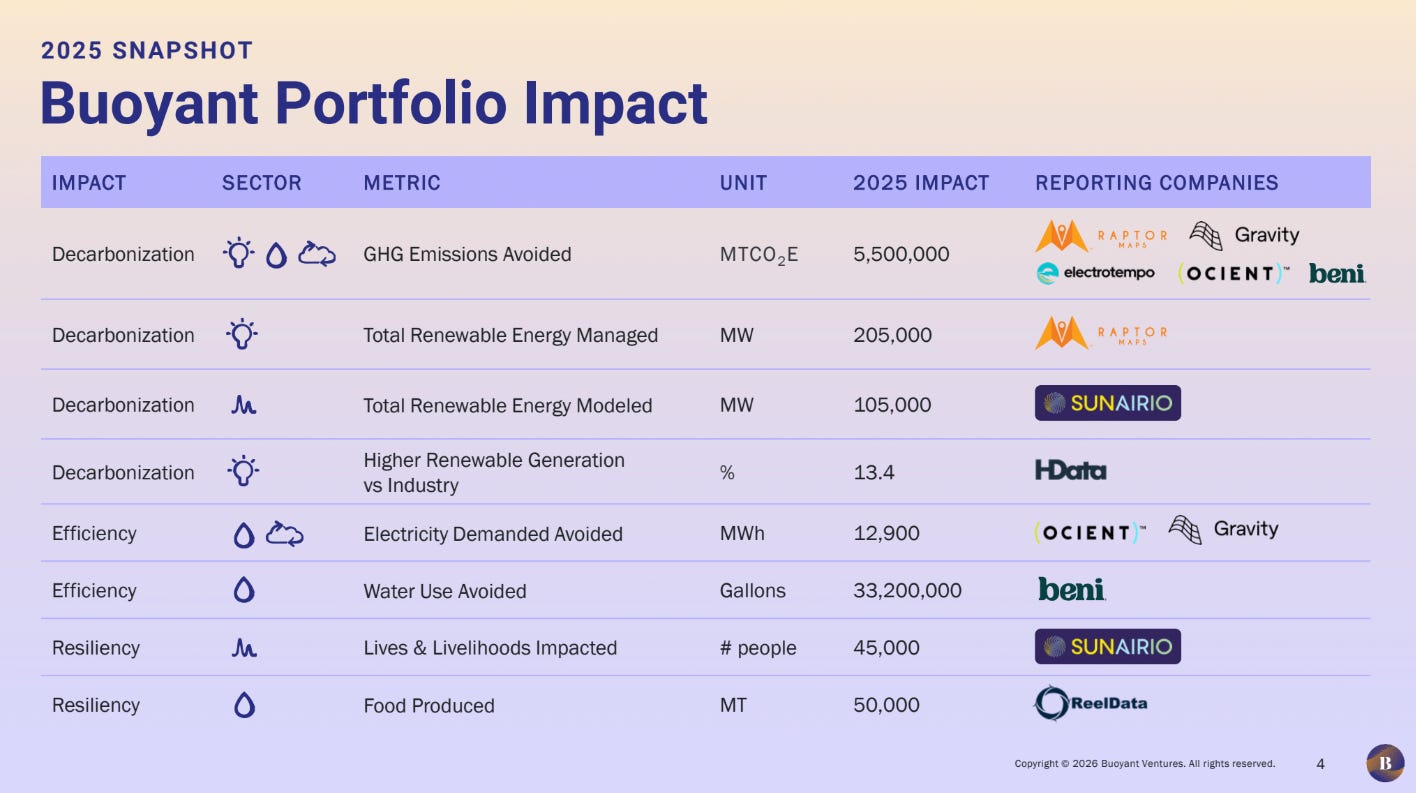
Buoyant’s 2025 Impact Report
Five years ago we started publishing an annual impact report because we wanted to hold ourselves to the same standard we ask of our founders: say what you are going to measure, then show the number. Our 2025 Impact Report is out now, and it lands at a moment when the question of whether climate outcomes and durable businesses can coexist has stopped being theoretical.
Climate tech has gone from consensus to a market defined by scrutiny and execution, and what emerged in place of that consensus is a healthier distinction between technologies that are merely promising and products customers urgently need. That distinction increasingly favors AI, software, and simple hardware.
Meanwhile, three simultaneous buildouts are converging into a single supercycle, and all three depend on software to function at scale. Hyperscaler capex is expected to reach nearly $690 billion in 2026 alone and $4.7 trillion between 2025 and 2030, with roughly 100 GW of new capacity coming online by 2030. Aggregate utility spending for 2026–2030 is forecast at a record $1.3 trillion. And companies announced $1.42 trillion in planned U.S. manufacturing investment between January 2025 and mid-March 2026. Capital is being committed at unprecedented scale — but capital alone doesn’t make systems efficient, resilient, or decarbonized. A 10% improvement in how infrastructure is built and operated represents trillions of dollars in value. That’s the intelligence layer, and that’s where we invest.
The report walks through what this looks like in practice. It also covers why LLMs strengthen rather than commoditize these businesses, the four themes shaping our next investments, and our full measurement methodology.
👉 Read the full post and request a copy of the impact report here
Portfolio Company Highlights:
Gravity was featured in Forbes on how AI is finding money hiding in corporate utility bills. Gravity’s new Utility Bill Management product deploys agents to retrieve bills and audits them against applicable tariffs (Forbes). Gravity also launched an AI agent for sustainability and energy teams in late July, along with a must read agent buyers guide (Guide).
HData partnered with IFS Copperleaf to embed HData’s regulatory and legislative intelligence directly into Copperleaf’s capital planning platform, which manages $2.9 trillion in global assets, helping utilities ground infrastructure investment decisions in current regulatory reality and better defend capital plans to regulators (PRWeb). HData also partnered with Recurve to combine verified customer energy data supporting 55 million meters nationwide with HData’s regulatory and legislative intelligence, aimed at faster program design and better-supported grid investment decisions (Recurve).
Ocient announced a strategic partnership with Siren to deliver a hyperscale AI investigations platform for sovereign national security and intelligence missions – pairing Ocient’s efficient hyperscale analytics with Siren’s investigative intelligence layer (BigDATAwire).
SkyFi announced two new products. First SkyFi for Esri: commercial satellite imagery is now seamlessly integrated into ArcGIS. Users can search archives, task new collections, and stream imagery directly into their existing workflows, which is especially valuable for utilities, energy companies, and anyone already living in the Esri ecosystem (SkyFi). Second, SkyFi MCP: Satellite imagery and geospatial analytics are now accessible through natural language in ChatGPT, Claude, and other MCP-compatible AI agents. A huge step toward making satellite imagery and geospatial analytics as easy to query as any other source of information (SkyFi).
Sunairio announced a data partnership with Grid Status, integrating ISO data so customers can monitor forecast performance, backtest trading strategies, and validate Sunairio forecasts against official ISO data at scale through a single interface and API (PR Web). Sunairio’s datasets were also independently validated by EPRI, which benchmarked them against ERA5, NSRDB, and the WIND Toolkit across 37 U.S. load centers plus specialized wind and solar observation sites for Constellation, finding Sunairio’s data matched or outperformed the leading public alternatives on the majority of accuracy metrics for temperature, wind, and solar irradiance. (EPRI Technical Brief)
What we are reading…
PJM anticipates new peak demand record as heat wave tests power grid, Utility Dive
Fireworks Come Early: A Retrospective of the July 1–3, 2026 Heat Event in PJM, Sunairio
The problem to solve is so much bigger than Phoebe Gates and Phia, Beni
Heat, Fire, Smoke and Storms Are Wreaking Havoc on the Economy, NYT
Massive disconnect of power roils largest US electric grid, Reuters
What we are watching…
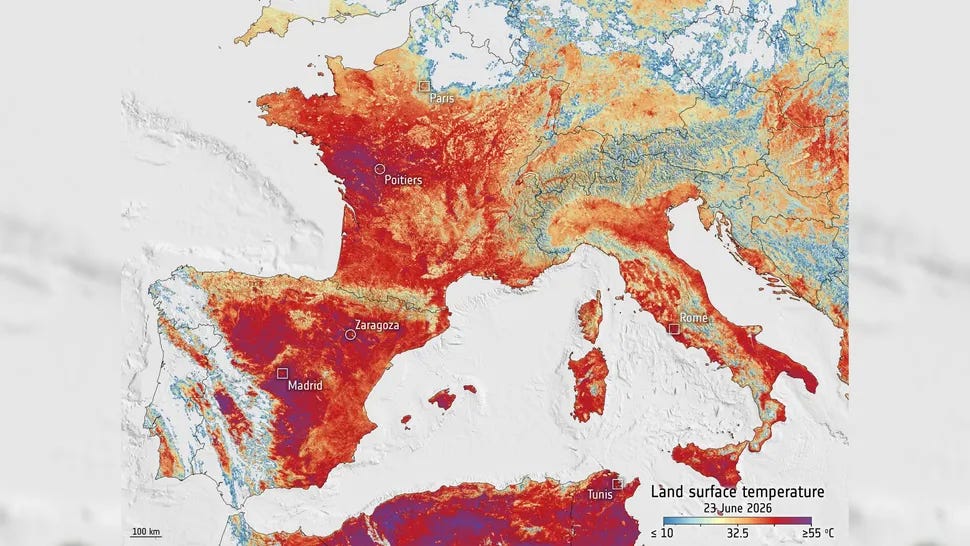
Europe’s 2026 heat waves, as seen from space: